Playing Tribute
(From mimics and mash-ups to show stopping similarities)
(From mimics and mash-ups to show stopping similarities)
Emulating or copying favourite vocalists and musicians is something we’ve all done.
Singing into hair dryers... tennis rackets as guitars... in front of mirror ‘rock star’ posing... turning pots and pans upside down and knocking the crap out of them with other kitchen utensils as we bang along to John Bonham or Buddy Rich.
But nowadays, if those actions are taken to their logical conclusion, hair dryers become microphones, rackets become guitars, mirrors reflect a real audience and the drum solos are authentic copies.
Suddenly we don’t have musical impersonations, we have tribute artists and cover bands.
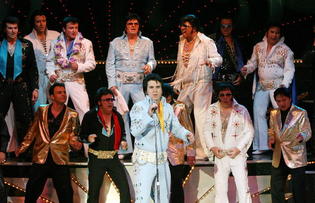
The first, and certainly most famous, were the Elvis Impersonators.
It was almost a case of The King is Dead Long Live the King because no sooner had Elvis curled his lip for the last time than the impersonators and tribute singers appeared, dressed in the Kingly attire and throwing their hunka hunka burning love across the stage floors.
You can see the attraction – one of the most famous and successful performers of all-time is no more, but people want to keep the musical legend alive and millions across the world are happy to pay to see the best of the tributes.
This generation’s equivalent is Michael Jackson, whose death is bringing life to more MJ tribute shows, musical homage events and Jackson song & dance impersonators than ever before.
But a tribute show doesn't have to be a nostalgia trip.
Some of the biggest bands on the planet, including the Rolling Stones and U2, have many a tribute band that pays and plays tribute to them. And some are very good indeed.
In fact a number of them are exceptional.
Some of the greatest ever bands who no longer perform, or no longer perform in their classic incarnations, have some excellent tribute alternatives.
Queen (in their original and, for many, only form), Led Zeppelin, Pink Floyd and Abba are four that immediately come to mind with the latter pair responsible for two of the most successful and renowned tribute bands to ever perform.
The Australian Pink Floyd Show (TAPFS) is so good, and the band so famous, that the performances have become arena tours.
Their lighting and set constructions emulate what Pink Floyd brought to stages around the world and TAPFS have also played the prestigious Royal Albert Hall in London.
Singing into hair dryers... tennis rackets as guitars... in front of mirror ‘rock star’ posing... turning pots and pans upside down and knocking the crap out of them with other kitchen utensils as we bang along to John Bonham or Buddy Rich.
But nowadays, if those actions are taken to their logical conclusion, hair dryers become microphones, rackets become guitars, mirrors reflect a real audience and the drum solos are authentic copies.
Suddenly we don’t have musical impersonations, we have tribute artists and cover bands.
The first, and certainly most famous, were the Elvis Impersonators.
It was almost a case of The King is Dead Long Live the King because no sooner had Elvis curled his lip for the last time than the impersonators and tribute singers appeared, dressed in the Kingly attire and throwing their hunka hunka burning love across the stage floors.
You can see the attraction – one of the most famous and successful performers of all-time is no more, but people want to keep the musical legend alive and millions across the world are happy to pay to see the best of the tributes.
This generation’s equivalent is Michael Jackson, whose death is bringing life to more MJ tribute shows, musical homage events and Jackson song & dance impersonators than ever before.
But a tribute show doesn't have to be a nostalgia trip.
Some of the biggest bands on the planet, including the Rolling Stones and U2, have many a tribute band that pays and plays tribute to them. And some are very good indeed.
In fact a number of them are exceptional.
Some of the greatest ever bands who no longer perform, or no longer perform in their classic incarnations, have some excellent tribute alternatives.
Queen (in their original and, for many, only form), Led Zeppelin, Pink Floyd and Abba are four that immediately come to mind with the latter pair responsible for two of the most successful and renowned tribute bands to ever perform.
The Australian Pink Floyd Show (TAPFS) is so good, and the band so famous, that the performances have become arena tours.
Their lighting and set constructions emulate what Pink Floyd brought to stages around the world and TAPFS have also played the prestigious Royal Albert Hall in London.
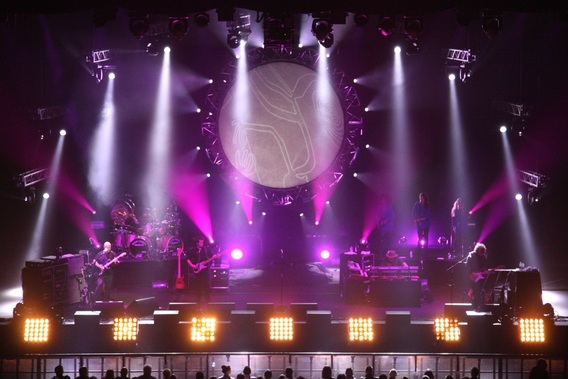
The Australian Pink Floyd Show, with the emphasis fully on the word "Show"
Bjorn Again, the ultimate Abba tribute (and another successful Australian export) made such an impact that they became an actual franchise – the official tribute brand – various Bjorn Again troupes perform all over the world.
Then there's The Beatles, who may have the largest number of tribute bands honouring their name and music. There are at least a dozen relatively popular and recognised Beatles tributes with one in particular deserving special mention...
The Bootleg Beatles have been performing since 1980 but it wasn’t until the mid 90s when they really made an impact, supporting Oasis at the Earls Court in London.
The band have since played festivals and theatres all over the world and have shared stages with the likes of David Bowie and Bon Jovi and seen by Sir Paul McCartney and the late George Martin.
They even performed at that well-known music theatre Buck Palace in front of some woman called Liz.
What makes the Bootleg Beatles such a draw is not just their solid musical ability, but the fact they dress, look and sound like the Fab Four, including the accents.
Their shows feature Beatles music performed chronologically and the associated costume changes present a Beatles history, from the early years through Sgt. Peppers to the rooftop finale.
It’s a fitting finish to their shows as in January 1999 the band played on the rooftop of what had been the former Apple Corps company, recreating the Beatles final public live performance exactly 30 years before.
(The band performed on the same rooftop in 2009, marking the 40th anniversary of the historic Beatles event).
Bjorn Again, the ultimate Abba tribute (and another successful Australian export) made such an impact that they became an actual franchise – the official tribute brand – various Bjorn Again troupes perform all over the world.
Then there's The Beatles, who may have the largest number of tribute bands honouring their name and music. There are at least a dozen relatively popular and recognised Beatles tributes with one in particular deserving special mention...
The Bootleg Beatles have been performing since 1980 but it wasn’t until the mid 90s when they really made an impact, supporting Oasis at the Earls Court in London.
The band have since played festivals and theatres all over the world and have shared stages with the likes of David Bowie and Bon Jovi and seen by Sir Paul McCartney and the late George Martin.
They even performed at that well-known music theatre Buck Palace in front of some woman called Liz.
What makes the Bootleg Beatles such a draw is not just their solid musical ability, but the fact they dress, look and sound like the Fab Four, including the accents.
Their shows feature Beatles music performed chronologically and the associated costume changes present a Beatles history, from the early years through Sgt. Peppers to the rooftop finale.
It’s a fitting finish to their shows as in January 1999 the band played on the rooftop of what had been the former Apple Corps company, recreating the Beatles final public live performance exactly 30 years before.
(The band performed on the same rooftop in 2009, marking the 40th anniversary of the historic Beatles event).
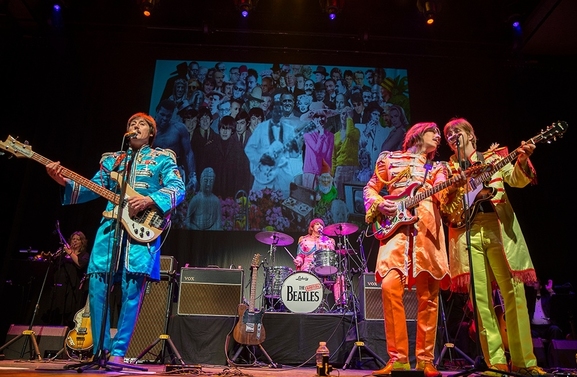
The all-era, costume changing Bootleg Beatles doing the Fab Four doing Sgt. Pepper
Bands such as TAPFS, Bjorn Again and the Bootleg Beatles are the exceptions to the tribute rule, however.
Generally, acts don’t have the promotion, finances or musical clout to deliver what the big boys and girls of the tribute world can; they are usually club or theatre performers paying tribute to the sound of an original artist and keeping that classic music alive.
They are also a great alternative for those that can’t afford to see the real thing, or where the original band/s no longer perform. And they are becoming more popular, with good reason...
The tribute scene was fairly healthy in the 1990s but as the 21st century dawned there were more tribute artists and cover bands than ever before – audience numbers for such acts started to increase courtesy of the fact that 60s and 70s classic rock, along with 80s melodic rock and pop, was having a resurgence.
Subsequently, many of those original artists either gained a new lease of new Millennium life, or reformed.
Others that couldn’t or wouldn't fully reunite, or had previously fragmented, ended up with more than one version of the original.
But no matter what shape (musically, financially or even physically) the bands found themselves in, just about every one of them had a tribute alternative.
And therein lies the curious relationship between tribute and original.
Many bands with twenty, thirty, or even forty and more years of history behind them still perform but some are a shadow of their former selves as regards later material and personnel (many such acts now perform with only one original member or one or two musicians from the "classic" era).
Invariably part of their "signature sound" is missing and/ or specific, key musicians are no longer part of the group because they have limited or zero interest in revisiting the past.
Or perhaps, sadly, the death of a of famous or pivotal band member means a full reunion is simply impossible.
And that’s where the best of the tribute acts come in, keeping the spirit alive of a classic band's musical era.
Many go so far as to not just perform in an intentional sound-a-like fashion, but in look-a-like fashion.
Others may present specific eras of bands, or stage their sets to recreate particular tours or set-lists of the past. A form of musical theatre, if you will.
The end result, somewhat ironically, is some of the original bands become a tribute or parody of themselves while the tribute band becomes the more faithful representation of the band they are covering. (Not all fans see it this way however; for every fan that appreciates or enjoys a tribute act there's another appalled by the very idea of an "imitation" while happy to pay bigger bucks for a band that might be only one member away from licencing the name).
And the line between tribute band and original act is becoming blurrier by the year…
When noted vocalist Rob Halford left Judas Priest in 1992 he was replaced by Tim "Ripper" Owens, whose previous included fronting the Judas Priest tribute band British Steel.
Halford rejoined the band in 2003 but the story was still big enough to inspire the 2001 movie Rock Star.
Tommy Thayer had been in a KISS tribute band Cold Gin, where he played the part of original KISS guitarist Ace Frehley.
But in a classic (rock) case of tribute life imitating artist, Thayer (who had previously worked with KISS as a songwriter and session guitarist) became Frehley's replacement in KISS in 2002.
When Rick Buckler and Bruce Foxton, original drummer and bassist of The Jam respectively, decided to go on tour and play Jam material in a band named From The Jam, the singer-guitarist was Russell Hastings.
Hastings had previously worked with Buckler in The Gift, a band put together in 2006 that played material by The Jam. Prior to that, Hastings had been in a Jam tribute band.
In 2008, Journey, looking to return to their "legacy sound," announced their new singer was to be Arnel Pineda; prior to being hired by Journey Pineda was fronting The Zoo, a covers band.
It was while browsing YouTube that guitarist Neal Schon came across Pineda performing Journey songs with The Zoo, leading to the vocalist being approached by the band.
Before the YouTube hunt Journey nearly went with Jeremey Hunsicker, a great singer in his own right but known vocally as the the front man of Journey tribute band Frontiers.
Probably the best of the Journey tributes, Frontiers went on to perform full-time touring across the United States, playing large halls and theatres.
When serious health problems kept Jon Anderson from touring with progressive giants YES in 2008, founder member and bass player Chris Squire replaced the seminal singer with Benoît David.
Prior to joining YES David was singer for the progressive rock band Mystery and fronted the Yes tribute band Close to the Edge (in remarkably similar circumstances to the Arnel Pineda hiring, it was while watching videos of David perform with the tribute band that Squire decided to contact the singer).
In 2012 YES parted company with Benoît David and recruited Jon Davison; the singer had previously fronted the progressive band Glass Hammer and also performed with the now disbanded YES tribute, Roundabout.
Cover bands, as opposed to tribute bands, have always been around and many groups that went on to become famous or successful served their musical apprenticeship as cover acts, honing their skills in the live environment (you could argue that's exactly what the Rolling Stones were for their first few years).
In general however cover bands play smaller gigs and may be known as a pub or club band.
But their ability to cover many styles of songs, or perhaps cover a specific genre or era (the Glam songs of the 70s, the hair and spandex acts of the 80s, etc.) makes them popular as a function or for-hire band.
Then there are the tribute-cover bands that perhaps concentrate on songs by one particular artist, but cover them in such a way that they bear little resemblance to the originals.
Dread Zeppelin primarily perform, unsurprisingly, Led Zeppelin numbers.
The difference is the Dread’s perform the songs in a reggae style, compounded further by the fact that the lead singer is an Elvis Impersonator.
The band have been touring and releasing albums since 1990 and it’s not just Zeppelin that get the tribute treatment – Bob Marley and the King himself are amongst the other artists given the Dread touch.
Dread Zeppelin - tribute band, tribute cover
The first album released by Hayseed Dixie was in 2001 and titled A Hillbilly Tribute to AC/DC.
That immediately tells you where the band’s name came from, what band was being covered and what style of music they performed.
The group then widened their hayseed horizons to become a bluegrass (or "rockgrass") tribute, covering classic rock songs by many an artist.
They also write their own material and have released an album of all original music.
In 2007 the band Beatallica released the album Sgt. Hetfield’s Motorbreath Pub Band which, as you may have guessed, is a collection of classic Beatles songs infused with Metallica riffs or lyrics, all performed in the style of Metallica.
Every home should have a copy.
But the Beatallica album is bettered by another covers-tribute hybrid.
In 2010 Rock Sugar released the album Reimaginator, featuring mash-ups of classic 80s pop, rock and metal tracks.
It’s not every band that can successfully mix Madonna and AC/DC, or even Journey and Metallica.
In the same song. And have as much fun doing it...
Bands such as TAPFS, Bjorn Again and the Bootleg Beatles are the exceptions to the tribute rule, however.
Generally, acts don’t have the promotion, finances or musical clout to deliver what the big boys and girls of the tribute world can; they are usually club or theatre performers paying tribute to the sound of an original artist and keeping that classic music alive.
They are also a great alternative for those that can’t afford to see the real thing, or where the original band/s no longer perform. And they are becoming more popular, with good reason...
The tribute scene was fairly healthy in the 1990s but as the 21st century dawned there were more tribute artists and cover bands than ever before – audience numbers for such acts started to increase courtesy of the fact that 60s and 70s classic rock, along with 80s melodic rock and pop, was having a resurgence.
Subsequently, many of those original artists either gained a new lease of new Millennium life, or reformed.
Others that couldn’t or wouldn't fully reunite, or had previously fragmented, ended up with more than one version of the original.
But no matter what shape (musically, financially or even physically) the bands found themselves in, just about every one of them had a tribute alternative.
And therein lies the curious relationship between tribute and original.
Many bands with twenty, thirty, or even forty and more years of history behind them still perform but some are a shadow of their former selves as regards later material and personnel (many such acts now perform with only one original member or one or two musicians from the "classic" era).
Invariably part of their "signature sound" is missing and/ or specific, key musicians are no longer part of the group because they have limited or zero interest in revisiting the past.
Or perhaps, sadly, the death of a of famous or pivotal band member means a full reunion is simply impossible.
And that’s where the best of the tribute acts come in, keeping the spirit alive of a classic band's musical era.
Many go so far as to not just perform in an intentional sound-a-like fashion, but in look-a-like fashion.
Others may present specific eras of bands, or stage their sets to recreate particular tours or set-lists of the past. A form of musical theatre, if you will.
The end result, somewhat ironically, is some of the original bands become a tribute or parody of themselves while the tribute band becomes the more faithful representation of the band they are covering. (Not all fans see it this way however; for every fan that appreciates or enjoys a tribute act there's another appalled by the very idea of an "imitation" while happy to pay bigger bucks for a band that might be only one member away from licencing the name).
And the line between tribute band and original act is becoming blurrier by the year…
When noted vocalist Rob Halford left Judas Priest in 1992 he was replaced by Tim "Ripper" Owens, whose previous included fronting the Judas Priest tribute band British Steel.
Halford rejoined the band in 2003 but the story was still big enough to inspire the 2001 movie Rock Star.
Tommy Thayer had been in a KISS tribute band Cold Gin, where he played the part of original KISS guitarist Ace Frehley.
But in a classic (rock) case of tribute life imitating artist, Thayer (who had previously worked with KISS as a songwriter and session guitarist) became Frehley's replacement in KISS in 2002.
When Rick Buckler and Bruce Foxton, original drummer and bassist of The Jam respectively, decided to go on tour and play Jam material in a band named From The Jam, the singer-guitarist was Russell Hastings.
Hastings had previously worked with Buckler in The Gift, a band put together in 2006 that played material by The Jam. Prior to that, Hastings had been in a Jam tribute band.
In 2008, Journey, looking to return to their "legacy sound," announced their new singer was to be Arnel Pineda; prior to being hired by Journey Pineda was fronting The Zoo, a covers band.
It was while browsing YouTube that guitarist Neal Schon came across Pineda performing Journey songs with The Zoo, leading to the vocalist being approached by the band.
Before the YouTube hunt Journey nearly went with Jeremey Hunsicker, a great singer in his own right but known vocally as the the front man of Journey tribute band Frontiers.
Probably the best of the Journey tributes, Frontiers went on to perform full-time touring across the United States, playing large halls and theatres.
When serious health problems kept Jon Anderson from touring with progressive giants YES in 2008, founder member and bass player Chris Squire replaced the seminal singer with Benoît David.
Prior to joining YES David was singer for the progressive rock band Mystery and fronted the Yes tribute band Close to the Edge (in remarkably similar circumstances to the Arnel Pineda hiring, it was while watching videos of David perform with the tribute band that Squire decided to contact the singer).
In 2012 YES parted company with Benoît David and recruited Jon Davison; the singer had previously fronted the progressive band Glass Hammer and also performed with the now disbanded YES tribute, Roundabout.
Cover bands, as opposed to tribute bands, have always been around and many groups that went on to become famous or successful served their musical apprenticeship as cover acts, honing their skills in the live environment (you could argue that's exactly what the Rolling Stones were for their first few years).
In general however cover bands play smaller gigs and may be known as a pub or club band.
But their ability to cover many styles of songs, or perhaps cover a specific genre or era (the Glam songs of the 70s, the hair and spandex acts of the 80s, etc.) makes them popular as a function or for-hire band.
Then there are the tribute-cover bands that perhaps concentrate on songs by one particular artist, but cover them in such a way that they bear little resemblance to the originals.
Dread Zeppelin primarily perform, unsurprisingly, Led Zeppelin numbers.
The difference is the Dread’s perform the songs in a reggae style, compounded further by the fact that the lead singer is an Elvis Impersonator.
The band have been touring and releasing albums since 1990 and it’s not just Zeppelin that get the tribute treatment – Bob Marley and the King himself are amongst the other artists given the Dread touch.
Dread Zeppelin - tribute band, tribute cover
The first album released by Hayseed Dixie was in 2001 and titled A Hillbilly Tribute to AC/DC.
That immediately tells you where the band’s name came from, what band was being covered and what style of music they performed.
The group then widened their hayseed horizons to become a bluegrass (or "rockgrass") tribute, covering classic rock songs by many an artist.
They also write their own material and have released an album of all original music.
In 2007 the band Beatallica released the album Sgt. Hetfield’s Motorbreath Pub Band which, as you may have guessed, is a collection of classic Beatles songs infused with Metallica riffs or lyrics, all performed in the style of Metallica.
Every home should have a copy.
But the Beatallica album is bettered by another covers-tribute hybrid.
In 2010 Rock Sugar released the album Reimaginator, featuring mash-ups of classic 80s pop, rock and metal tracks.
It’s not every band that can successfully mix Madonna and AC/DC, or even Journey and Metallica.
In the same song. And have as much fun doing it...
Many mash-up, cover and tribute bands are so popular that they don’t just succeed on the circuit – albums released by these bands also sell well.
Which helps prove the earlier point about some of these bands being better than the originals, or at least the later incarnations of the original, classic acts.
A large number of tribute bands have loyal followings that go to see these groups perform whenever and wherever they can and purchase the tribute artists' CDs and DVDs, far happier to do so than give the same time but a lot more money to the established, original acts.
Talon: The Best of Eagles are a particularly good, and exceptionally talented, example of this Tribute Fan dynamic – even more so now that the Eagles have almost certainly ended as an entity with the sad passing of Glen Frey in January.
Make no mistake – whether paying tribute or going through the classic pop and rock songbook from cover to cover, these bands have a part to play in the modern musical era.
And the best of them play it very well.
Ross Muir
July 2016
(after the original 2010 article)
Photo Credits:
Ethan Miller / Getty Images (Elvis impersonators); Wendy Wilson (TAPFS); Peter Balkema (Bootleg Beatles)
Which helps prove the earlier point about some of these bands being better than the originals, or at least the later incarnations of the original, classic acts.
A large number of tribute bands have loyal followings that go to see these groups perform whenever and wherever they can and purchase the tribute artists' CDs and DVDs, far happier to do so than give the same time but a lot more money to the established, original acts.
Talon: The Best of Eagles are a particularly good, and exceptionally talented, example of this Tribute Fan dynamic – even more so now that the Eagles have almost certainly ended as an entity with the sad passing of Glen Frey in January.
Make no mistake – whether paying tribute or going through the classic pop and rock songbook from cover to cover, these bands have a part to play in the modern musical era.
And the best of them play it very well.
Ross Muir
July 2016
(after the original 2010 article)
Photo Credits:
Ethan Miller / Getty Images (Elvis impersonators); Wendy Wilson (TAPFS); Peter Balkema (Bootleg Beatles)